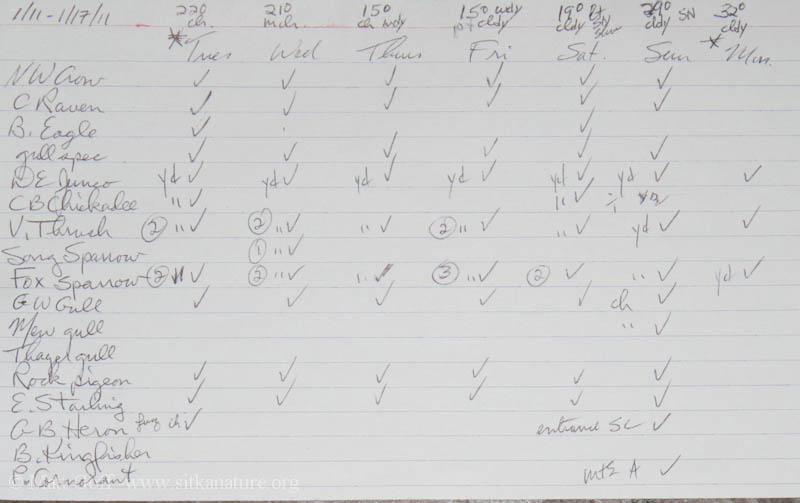
Marge Ward has lived in Sitka for over 60 years and Marlys Tedin nearly as long. They have been recording their daily bird observations since 1980 using 5×7 inch note cards, with a row for each species. This time of year the number of species they observer in a given week doesn’t usually require more than two cards, though at other times they may nearly fill three. Marge often writes additional notes on the back giving additional details about some observations of particular interest, weather observations, or reports of non-bird plants and animals.
Although their records are an amazing store of information about bird occurrence in the Sitka area, it is not so easy to sort through and access in card form. Over the past year or so, I’ve started working to get their observations into a computer database by using a CyberTracker application I created for that purpose. Last winter I made some progress on getting through the historical records, but as the season changed, I became busy with other things and have done little work on the older records since then. I have kept up with current observations, however. I try to visit them most Fridays to get the most recent week’s observations put in.
My only significant time outside today was walking over to Marge and Tedin’s place. Temperatures have continued to be in the upper 30s and low 40s, and although the ground remains frozen, most of the surface snow and ice in the central part of town is gone. It had been some time since I was by Swan Lake, and I was interested to see that it remained covered in ice, though the ice had an inch or more of water on top of it. (I remember walking/skating across the ice in such conditions more than once when I was on my way home from my paper route – but I don’t think I would feel comfortable doing it these days.) Despite the lack of open water, there were 45 or more Mallards and over 10 Glaucous-winged Gulls at the peninsula.
While visiting with Marge and Tedin, I mentioned that robins had been around this past week, but they said they hadn’t seen any at their place. Apparently, in winter at least, the robins prefer other neighborhoods. We also talked about the arrival of Pine Siskins at feeders this week. There had been a individual Pine Siskin or two visiting the feeders at my house, but today there was a sizable flock feeding on the ground in the neighborhood, and making stop by our feeders. I noticed another flock foraging on a gravel driveway along Lake Street – I suspect they were going after conifer and/or alder seeds that were probably released during the last cold snap. Marge commented that the first flock of siskins she had seen at their feeders in a while was today as well.
During our visit we had commented on the abundance of Varied Thrushes this year. I mentioned seeing a couple of loose flocks while on a hike up Indian River last weekend. It was interesting because they weren’t together like a flock of starlings or finches might be, but rather moving in a much more distributed association. When Marge and Tedin dropped me off at the bottom of the hill, we saw 10 or more Varied Thrush – most of them foraging on a mossy roof, but a few more poking about on the gravel road in front of the maintenance building. When they spooked as I got out of the car, they all flew off in the same direction, but only one or two at a time.